Homestuck: between game and story

            Today, we take a short break from our astronaut duo to discuss Homestuck: a work by Andrew Hussie that begins as parody of text adventure games. Originally, the story would progress through the suggestions of readers, written as “commands”.

Found on https://www.homestuck.com/. The command is seen on the bottom.

            Later, this system would be replaced with commands written by the author himself in order to maintain a semblance of order in an increasingly complex plot. However, the story still maintains many other game-like mechanics, like the sylladex mechanic.

Found on https://www.homestuck.com/. The inventory system consists of chip-like cards, and each kid has unique system(s) of storage and retrieval.

            In this world, items are not picked up; they are stored in an inventory. This is one of many distinctions from our world and the Homestuck world, and these mechanics are distinct from the mechanics of SBurb, the reality-warping game that the kids in Homestuck play.

Found on https://www.homestuck.com/.
Found on https://www.homestuck.com/. John’s room is expanded.

            Here, a friend of John (the boy in the room) modifies John’s room, much like we would see in The Sims.

            This webcomic certainly takes advantage of many of the affordances of digital media. The above two pictures are two frames of an animated GIF. Other “pages” are not only animated, but also come with sound. One page early on is even interactive, and strips even further on play out like actual minigames.

Found on https://www.homestuck.com/. The buttons “Aggrieve” and “Abjure” can be clicked for extra animations.

            How could such a work be remade into a book without doing the comic a disservice? Hussie’s simple answer is that it cannot; as he states in the book copy, “I see the books more as complementary material.” He simply leaves numbers in the corner of each page that correspond to those pages’ web versions.

            Perhaps this is the reason that the Homestuck book manages to be successful; it is never marketed as a replacement for the webcomic, and instead is advertised as offering something completely unique: author commentary. If we take Hussie’s book as an example to look up to, then we see that book versions of comics need not even add bonus strips or extra in-story content. In fact, the most we are given are a few quips and inside thoughts on the bottom of the page, and a fancy book cover.

Perhaps commentary and nothing else is the exact recipe for success; buyers feel more like they are supporting the author and getting personal thoughts as a bonus, as opposed to when they purchase a whole book for a few extra strips with nothing to make those strips special other than the fact that they cost money.

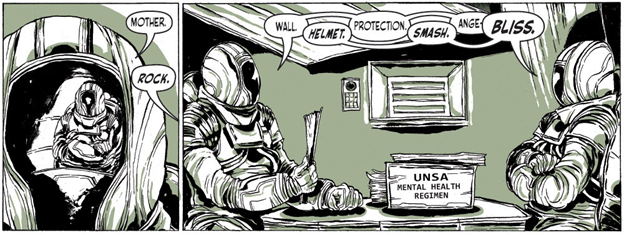
In “The Loneliest Astronauts”, Kevin Church and Ming Doyle depict two astronauts stranded in space—but instead of being dramatic, the tone set is humorous.

Found on http://www.agreeablecomics.com/loneliestastronauts/?p=113

            My group read a chapter of Kashtan’s Between Pen and Pixel, where Kashtan notes that a comic does not need to be exclusively either online or in print. In fact, he notes that the webcomic can serve as a cheaper option to prove a concept as successful before being printed. All content creators need to get money somehow, and this is reflected in comic design. That is, while some webcomic artists embrace the affordances of online media, many keep their comics designed so they can be easily translated to print for sale. (Kashtan 2018)

            Indeed, the creators of the “The Loneliest Astronauts” did consider a book release of their comic; their last page declares this, and on the top bar there is an option to “Buy In Print”.

Found on http://www.agreeablecomics.com/loneliestastronauts/, the last page of the comic and the home page of the website
Found on http://www.agreeablecomics.com/site/?page_id=428, the page we are redirected to when clicking “Buy In Print” on the page above

 But as we see here, all the link gives us is a broken webpage. While the comic has sold merchandise in the past, it is no longer available. Why not? Clearly, the strips have been designed with print in mind—all the panels are rectangular and are all the same size. There would be no significant changes to the comic in the conversion to print.

Found on http://www.agreeablecomics.com/loneliestastronauts/?p=68

I believe that the comic’s low potential to spread may be at fault. Only some of these strips make complete sense when taken out of context. The strip above is an example; there’s no explanation for why Steve is so pessimistic, so the whole strip feels like half a joke. There is little to convince people to investigate.

That is not to say that the webcomic as a whole is low quality. However, the background needed to enjoy it requires a time investment that few are willing to pay. If this comic started out as a book, it might have been successful as a buyer would have already paid for it, and so is already invested; however, it would be difficult to sell something like this to a publisher without proof that it would work out. It appears that the system that causes so many webcomics to be successful comes at the cost of comics where interest investments are front-loaded.

Kashtan, A. (2018). Between Pen and Pixel: Comics, Materiality, and the Book of the Future. The Ohio State University Press.

On the Interaction Between the Author and the Rest of the World

            In “The Loneliest Astronauts”, Kevin Church and Ming Doyle depict the antics that occur between two astronauts stranded on a desolate moon.

found on http://www.agreeablecomics.com/loneliestastronauts/?p=25
Found on http://www.agreeablecomics.com/loneliestastronauts/?p=72

In this blog post, I would like to discuss Misemer’s approach to analyzing webcomics, which “considers them, not just as comics, but as a series of webpages” (Misemer).

Indeed, while the webcomic can be read on its own, I found myself reading the descriptions below each page, along with the comment section below it. Along with adding to the experience of reading the comic, the comment section allows the audience to communicate with the author far more easily than the audience of a print comic; the comment section being on each page makes it more convenient than sending an e-mail. Not only that, but the author can conveniently respond to a commenter or add to the discussion among commenters.

Found on http://www.agreeablecomics.com/loneliestastronauts/?p=74

            This connection with others who are reading the comic is like watching a movie in a movie theatre (rather than at home alone); it is almost like they are reading alongside you. Additionally, the connection with the author’s thoughts and commentary is like watching a movie with the director—it is a strange experience, but not an unwelcome one, and having insight of what the author is thinking can be fun.

Found on http://www.agreeablecomics.com/loneliestastronauts/?p=80

While our weekly article emphasizes the strength of the bond between producers and consumers, which this webcomic demonstrates, the webcomic also demonstrates a bond between the producer and other producers. Here, we see one of many “guest strips”, this one by artist Katie Cook. The sudden art style difference between this strip and the last one is initially jarring, but it makes a new and arguably better journey. We watch not only the adventures of Dan and Steve the astronauts, but of Kevin Church and his growing relationships with other artists. Because webcomics are a relatively new form of literature that is rapidly blooming, the importance of networking to stay relevant cannot be stressed enough. While book writers might interact and borrow ideas from each other, we rarely see this level of interaction, where the one artist directly contributes to another work’s cannon; we rarely see television shows with “guest directors” or books with “guest chapters”. Here, we see that new level of interaction in action.

Misemer, Leah.  “ Webcomics. ” Keywords in Comics Studies . New York: NYU Press,  forthcoming.  

Webcomics…in Space!

            I will be following “The Loneliest Astronauts”, a webcomic by Kevin Church and Ming Doyle. The story follows two astronauts who are stranded on a moon far from Earth with no hope of rescue or communication with other people. However, rather than focus on the survival aspect of being stranded, the webcomic focuses more on the struggle that comes with a lack of any human contact other than each other.

            I chose this comic because I was interested in how a story with only two characters and limited resources progresses. There are only so many props that can be reasonably brought into the setting—only the necessities that the astronauts would bring on a short mission. I was also hooked by the twist in the description: “The worst part of all this? They hate each other’s guts.” While the first few pages of the webcomic shows that this is exaggerated, it is still fun to watch how the interplay between the negative relationship between the characters and the human need for company plays out.

            As analyzers of webcomics, we have much to gain from the creativity that comes from constraints. The aforementioned shortage of characters and resources means that the author must use them carefully, or they will run out of material to write with. Additionally, the fact that the astronauts almost always have their helmets on (and thus their faces are hidden) means that personality and emotion can only be conveyed through body language and dialogue.

Two astronauts, Dan and Steve. Dan is holding a bucket. Steve is reading a book. Dan asks Steve to draw a slip for Secret Santa. After Steve draws, Dan tells Steve not to tell the person he got, and that there is a ten dollar limit. Steve draws himself.
Found on 0www.agreeablecomics.com/loneliestastronauts/?p=123

            Here, we see that the astronaut Steve is a reader and/or a nosy person by the fact that he is reading someone else’s journal. We can also see that he is a serious and sarcastic character through his responses to the astronaut on the left of the first panel, Dan. On the other hand, we can see that Dan is an upbeat person; all of his sentences end in exclaimation points, and he is celebrating Christmas despite being stranded. However, he is also unintelligent, as seem by the fact that he does not consider that there are only two people in the Secret Santa, and so the results of the draw are obvious to both of them.